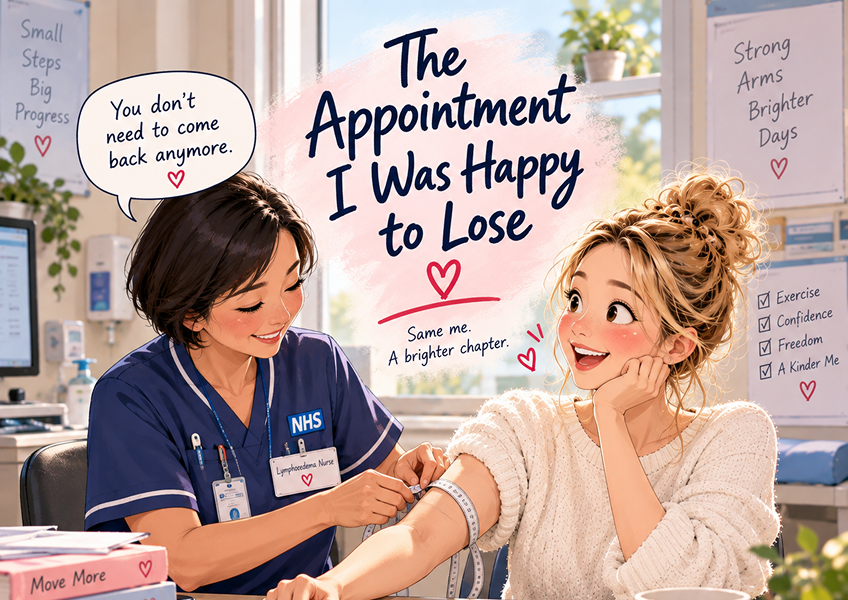
The Appointment I Was Happy to Lose

In 2025, my lymphoedema nurse measured both my arms and told me:
“You don’t need to come back anymore.”
I was genuinely thrilled.
She had followed me for years. At first, I saw her every few months, then once a year. In 2024, I even forgot my appointment and we ended up doing it over the phone. So when I walked into her clinic in 2025, she hadn’t seen me for two years.
She looked a little surprised.
I knew why. I looked different. I had started exercising regularly, eating better and building strength. I looked healthier and, more importantly, I felt healthier.
But five years earlier, I had been frightened of using my right arm at all.
After breast cancer surgery, my right hand once swelled so badly that holding a pen felt strange. My fingers felt tight around it. I remember thinking: what if one day I can’t use this hand properly?
I started imagining practical solutions to a problem that hadn’t even happened yet. Perhaps I should learn to write with my left hand. Perhaps I should eat with it too.
For a while, my right arm became a lady of leisure.
Shopping bags? Left hand.
Exercise? Left arm.
The right one was apparently retired.
Eventually, I realised that being careful with my body didn’t have to mean being afraid of it.
I started very small. A water bottle. A resistance band my physiotherapist had given me after treatment. One-kilo weights, then two, then three.
One surprisingly useful lesson came from a YouTube workout. The trainer would do a set of movements and then stop for ten seconds.
Rest.
It sounds ridiculously obvious now, but I hadn’t really understood its importance. I had thought exercise meant doing as much as possible. Instead, I began learning a different rhythm: move, rest, see how my body responds, then move again.
That changed everything.
Over the next few years, I tried all sorts of exercise — walking, swimming, yoga, Pilates, gym machines, tennis, cycling and dancing.
Some disappeared almost as quickly as they arrived.
Tennis, for example, required a court, decent weather and preferably another human being who actually wanted to play with me. London rain did not help.
Swimming was much less demanding.
There was a large pool near home. I could go alone, swim fast or slowly, stay for as long as I wanted and leave without disappointing anybody. Walking was even easier: I had the river nearby.
Eventually I understood that the best exercise for me wasn’t necessarily the most exciting one. It was the one that fitted easily into my life.
By 2026, movement no longer felt like rehabilitation.
It was simply something I did.
On a nice day, I walked. When I wanted to swim, I swam. At home, I developed a small upper-body routine — stretching and moving my shoulders in the morning, sometimes again while cooking, sometimes before bed. Five minutes counted. Ten minutes counted.
And then something unexpected happened.
I had started exercising because I wanted my body to work better. I hadn’t expected to enjoy the way it changed.
My shoulders opened up. My arms and back became more defined. I had fewer stiff-neck mornings. Clothes sat differently on me. In photographs, I seemed more awake.
In my forties, I found myself enjoying a body that wasn’t simply thinner, but stronger and more defined. There was a kind of mature beauty in it that I hadn’t expected.
None of this means surgery left no trace.
When I swim backstroke, I sometimes drift towards the lane rope until my right hand bumps into it. My body isn’t quite as balanced as it once was.
I notice.
But I still swim.
And that, perhaps, is what changed most.
There was a time when every small change in my arm frightened me. I watched for swelling, redness, tightness — always looking for evidence that something might be getting worse.
There was also a time when my weeks seemed to belong to hospitals. Tests, injections, follow-ups, another appointment and then another. Each appointment was necessary, but each one also quietly reminded me that I was still a patient.
So when my nurse finally said, “You don’t need to come back anymore,” I wasn’t happy simply because I had one less appointment in my calendar.
It felt like another part of my life had been handed back to me.
I still have a body that carries the effects of what happened. But I no longer spend my days wondering what it might lose.
Now I notice what it can do — and, little by little, how much better I am becoming.