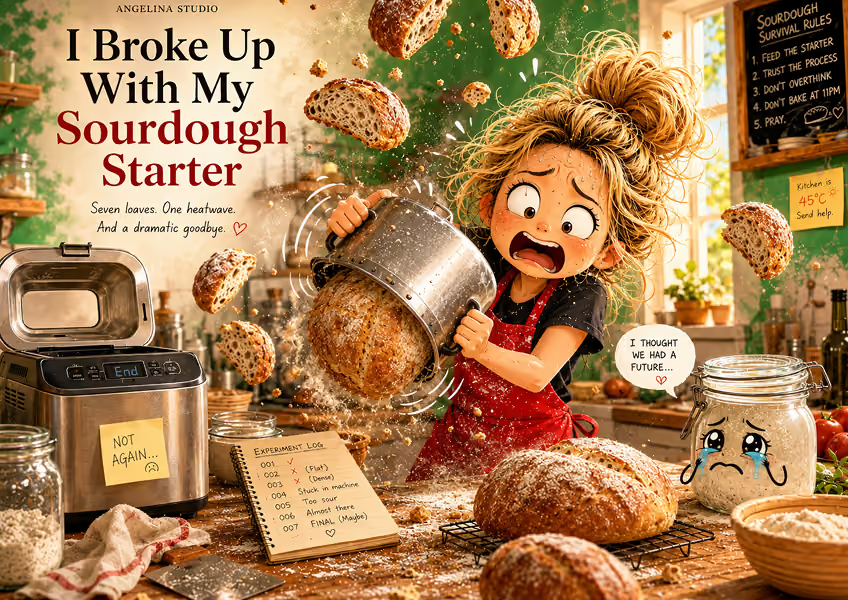
I Broke Up With My Sourdough Starter
%402x.svg)
The Announcement
When I told my husband, “This is the last sourdough bread I’m making this summer,” he stopped and looked at me.
For a second, I thought I saw tears in his eyes.
It was the same look a child might give you if you said, “Sorry, we are not doing Christmas this year.”
“Why?” he asked. “I really like this bread.”
I looked at him.
Then I looked at the bread.
Then I looked at our kitchen, which felt about 45°C.
Outside, London was in a heatwave.
Inside, I was running a small volcanic bakery.
Seven Loaves in Two Weeks
Over two or three weeks, I made seven sourdough breads.
Seven.
One loaf was still on the counter. Another one was already being born. And the starter in the jar looked at me every day like, “So… are we baking again?”
This is the problem with sourdough starter. Once you bring it to life, it becomes a tiny kitchen pet. You feed it, watch it, worry about it, and somehow feel emotionally responsible for a jar of flour and water.
So I kept baking.
The Good, the Flat, and the Stuck
Loaf 001 was not perfect, but it was alive. For me, that was already a miracle.
Loaf 002 overproofed all night. It became flat, very sour, and slightly tragic. I thought it was my worst one. My husband said it was delicious. This is marriage.
Loaf 003 was my favorite. No added yeast, more open crumb, and the closest to a classic sourdough. For a moment, I felt like I actually knew what I was doing.
Then came the bread-machine version.
In theory, it was supposed to be easy. Press the button, let the machine work.
In reality, the bread refused to come out. I shook the pan for what felt like ten minutes. At some point, I was no longer baking. I was negotiating with a trapped loaf.
The Final Version
By the seventh loaf, I became more practical.
I added a tiny bit of yeast.
So no, it was not a pure sourdough. If the sourdough police ever come to my house, I will confess.
But for a real family kitchen, it worked.
The bread machine helped with the dough. Then I took it out, folded it by hand, let it rest again, and baked it. It became something like a family-style sourdough toast: softer, more stable, easier to slice, and much less stressful.
Not perfect.
But useful.
And sometimes useful is exactly what a home kitchen needs.
Why I Had to Stop
Sourdough does not care if you are tired.
It does not care if it is 10 p.m.
It does not care if your kitchen is already hotter than outside.
Also, our family simply cannot eat that much bread. My husband loves it, but my son and I do not eat enough to justify two or three loaves a week.
Pizza makes more sense in summer. It goes into the oven and comes out about 13 minutes later.
Sourdough asks for commitment.
Pizza asks for cheese.
The Sentence That Changed Everything
Then my husband said something that stayed with me.
He told me that some bread from outside makes him cough, especially dry crusty bread with lots of crumbs and flakes. But my bread does not make him feel that way.
I do not want to turn that into a medical claim. Maybe it is the freshness. Maybe it is the texture. Maybe homemade bread is simply softer for him in the first few days.
But suddenly, all the work felt different.
The starter.
The flour.
The waiting.
The folding.
The hot oven.
The kitchen sauna with carbohydrates.
I had been thinking, “Why am I doing all this when I can buy bread for three or four pounds?”
Then he said my bread felt better for him.
And suddenly, it made sense.
Goodbye, Little Starter
So I said goodbye to my starter.
Was it dramatic?
Yes.
Did I feel guilty?
A little.
But I could not keep baking sourdough in a heatwave.
This is not the end forever. Maybe in autumn or winter, when the kitchen is cooler and the oven feels like a friend again, I will start over.
For now, I am proud of my seven loaves: the flat one, the sour one, the stuck one, the beautiful one, and the final one.
Sometimes you do something to learn.
Sometimes you do it to feed your family.
And sometimes, after seven loaves and one very hot kitchen, someone you love takes a bite and says:
“I really like this bread.”
And suddenly, all the flour on the counter feels worth it.
.svg)



.png)