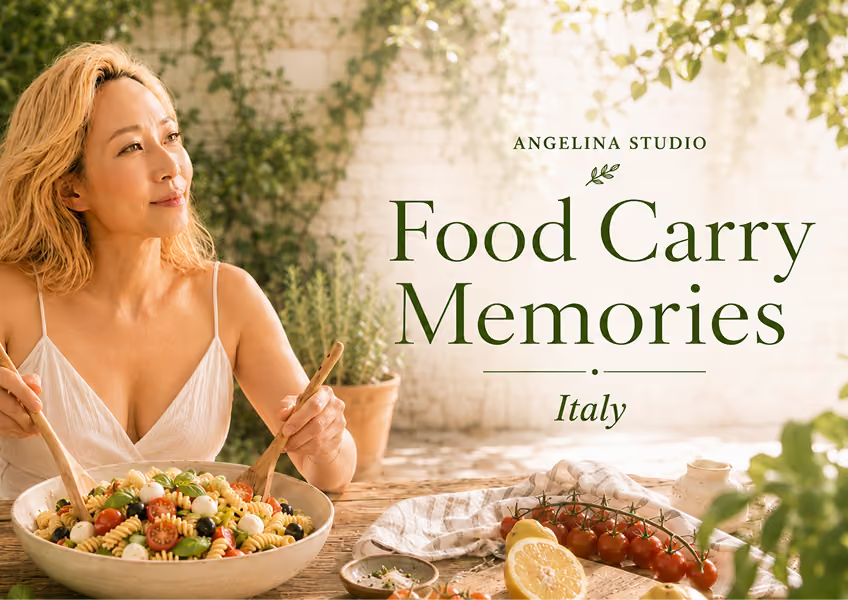
Food Carries Memories: Pasta Fredda and Italy
%402x.svg)
Pasta fredda always reminds me of summer in Italy.
My husband is Italian, and I once lived in Rome for a few years. Unlike Japan, where I had been a student, Italy entered my life through family. I was a young mother and daughter-in-law, learning a new home, a new rhythm, and a very different way of living.
The first thing I remember about Rome is the light. Apart from winter and rainy days, it often felt as if the sky was always blue and the sun was always there. Morning after morning, the city woke up under clear light. That kind of weather changes the way people live. Life naturally moves outdoors — to cafés, markets, seaside towns, mountain houses, and long family tables.
Pasta fredda was one of those summer foods.
In our family, we usually made it with mozzarella, tomatoes, olives, ham, tuna, sweetcorn, basil, and olive oil. Apart from mozzarella and tomatoes, the rest could be flexible. You could add what you liked, or what you already had in the kitchen.
Maybe that is part of its charm.
It does not ask for perfection. It is easy, colourful, and generous. A big bowl of pasta fredda can sit on the table, ready for lunch, dinner, or a second helping later in the day when nobody wants to cook again.
My mother-in-law is from Umbria, and most of the time, pasta in the family was served warm. But in summer, when Rome became too hot and the kitchen felt too heavy, pasta fredda appeared.
For me, it became the taste of an Italian summer.
When I think of summer in Italy, I remember colours. Bright beach clothes. Striped umbrellas. Gelato shops filled with pink, green, yellow, and chocolate-brown flavours. Then, in contrast, the quiet stone houses in the mountains, pale and simple under the sun.
Italy taught me that life could have more than one rhythm.
In Japan, I learned independence, self-confidence, and the habit of holding myself to a high standard. Life there felt tight, efficient, and carefully arranged. Italy gave me something very different. It showed me that life did not always have to be rushed.
In Italy, lunch could begin at one thirty and finish at three. First pasta, then meat, then vegetables, then maybe bread with ham, then fruit, then coffee, and sometimes gelato after that. After lunch, someone might take a nap, wake up at four, and then continue with the rest of the day.
At first, I found this almost unbelievable.
But slowly, I understood that this was not laziness. It was a way of living.
There always seemed to be a reason to gather. A birthday, a baby shower, a wedding anniversary, a religious holiday, a village festa. Life was marked by meals, visits, coffee, and celebrations. Sometimes it felt as if every month had its own festival, and every season gave people a reason to pause.
Of course, Italy was not a perfect place, and I do not romanticise every part of life there. As a foreign woman, I sometimes felt the quiet distance between belonging and observing. At family gatherings, people were kind and would speak to me. At other gatherings, I could feel more like someone standing at the edge of the circle.
But even that became part of my understanding. A place can be warm and difficult at the same time. It can welcome you in some ways, and still remind you that you come from somewhere else.
What stayed with me most was its rhythm.
In summer, many Italian families went to the mountains or the seaside. Some stayed for a few days. Some stayed for weeks. In my husband’s family, the mountain house was part of childhood memory — snow in winter, cool air in summer, relatives gathering again, and long conversations about everything that had happened during the year.
There was a phrase I heard often in Italy: piano piano.
Slowly, slowly.
There was also another question I heard everywhere: Vuoi un caffè? — Would you like a coffee?
Even a short coffee could become a small pause in the day.
Now, when I make pasta fredda in my kitchen, I do not only remember a dish. I remember Rome in summer, mountain holidays, family lunches, afternoon naps, festas, coffee, and the feeling that life can be lived with more softness.
Pasta fredda reminds me that food does not only carry taste. It carries a rhythm.
It reminds me not to turn every day into a task list.
Sometimes, we are not here only to hurry, achieve, and move on.
Sometimes, we are here to sit down, share a bowl of something simple, and remember that being alive is also a way of living.
.svg)



.png)