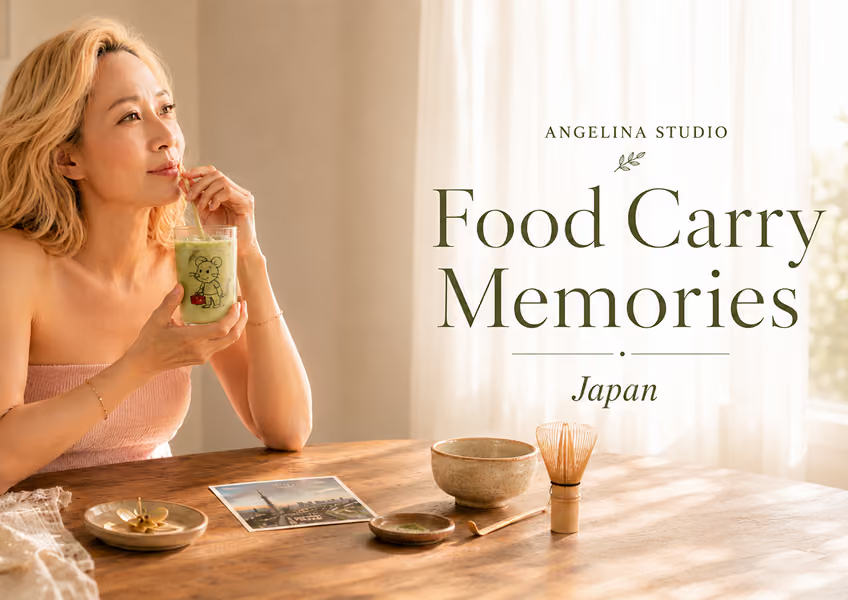
Food Carries Memories: Matcha Latte and Japan
%402x.svg)
The first time I had a matcha latte was in Japan, in a café in Ginza.
I still remember the feeling. I had been walking around the city, and I stepped into a café with a small cashier area downstairs and a quiet seating space upstairs. I ordered a matcha latte, took a sip, and thought, *How can something taste this good?*
At that time, matcha latte felt like a special drink. Matcha itself belonged to a more traditional and elegant world, connected to tea ceremony and Japanese culture. But matcha latte felt like a modern version of that taste — softer, creamier, and easier for young people to enjoy.
What I loved was the balance.
It was bitter, but also sweet.
It was sweet, but not empty.
There was a quiet aftertaste, the kind that only tea can leave behind.
When I make matcha latte now in my kitchen in London, the taste is not exactly the same. But the colour, the smell, and that gentle bitterness still bring Japan back to me.
I think of Tokyo streets. I think of small cafés near stations, the kind of places where you could sit down on a hot summer day, order a drink, maybe eat a simple curry rice or a small lunch set, and rest for a while before going back into the busy city.
Japan was my first step outside China. Tokyo was the city where I learned how to live on my own.
Before Japan, the world outside my home country was still an idea. After Japan, it became real — with train stations, classrooms, part-time jobs, rent, loneliness, friendships, deadlines, and small joys bought with the money I had earned myself.
During my student years, life was not easy. Classes started in the morning and finished in the afternoon. After that, many of us went straight to part-time jobs. We worked until late evening, went home tired, made coffee, ate something simple, and opened our laptops to write essays.
I still remember those late nights. Around ten o’clock, people would appear online on MSN. Someone would ask, “Have you started the essay?” Someone else would say, “Not even one word.” Then we would laugh, panic a little, and keep writing until two or three in the morning.
Those days were exhausting, but they were also full of youth, dreams, and effort.
Looking back now, I realise that Japan did not only give me an education. It gave me a different shape of myself. It taught me to live on my own, to trust myself more, and to hold myself to a higher standard.
This year, I went back to Japan with my family. I had missed Japan for a long time, and being there again brought many memories back to me. But I also realised that I was no longer the same person who had once arrived there as a young student.
At that time, I needed energy, order, and a city that could push me forward. Tokyo gave me all of that.
Now, at this stage of my life, I find myself longing for something different — a little more space, a little more nature, and a city where many cultures can sit beside each other quietly.
It does not mean Japan is less beautiful to me. It only means that the place we once loved may not always be the place we need in every season of life.
Some places are not meant to hold us forever. Some places are meant to open a door.
Japan opened a door for me.
Now, many years later, I am no longer that student. I am a mother. I live in London. I have moved through different countries, different homes, and different versions of myself.
But when I whisk matcha into milk, I can still feel a small part of that younger woman beside me.
She is tired, but hopeful.
She is far from home, but moving forward.
She is afraid sometimes, but she does not stop.
Food carries the places we once lived.
And sometimes, when we make something simple in our own kitchen, we are not only making a drink.
We are touching a memory.
We are thanking a place.
We are saying hello to a version of ourselves who helped us become who we are today.
.svg)



.png)