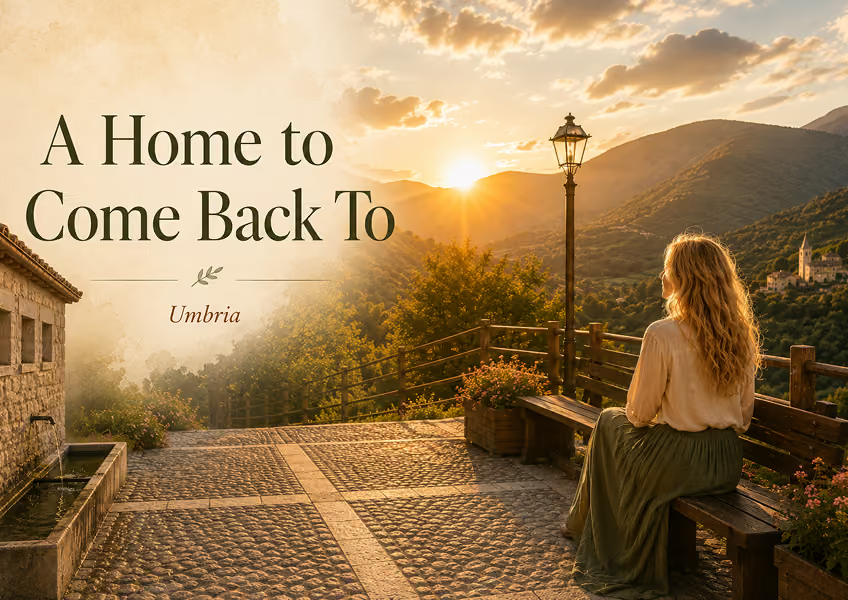
A Home to Come Back To
%402x.svg)
This summer, I asked my mother-in-law a question I had somehow never asked before.
“Where were you born?”
She pointed to the house we were staying in.
“Here.”
I had always known that the house had been in her family for generations. But until that moment, I had thought of it mainly as the family’s holiday home in the mountains of Umbria. Suddenly, I understood that it meant much more to her.
She was born in this house, at a time when babies in the village were often delivered at home by a midwife. She lived here until she was thirteen, when her family left the mountains for Rome.
Years later, the house was badly damaged by an earthquake. With some government support and the family’s own money, it was rebuilt. My mother-in-law kept coming back, and when she had children of her own, she brought them with her.
For the children, the mountain house became a second home.
Whenever school holidays arrived, they left their smaller home in Rome and came up here. In winter, there was snow. In summer, there were forests, football, barbecues and the freedom to spend hours outside.
The mountains also gave them something city life could not: a connection with rural life. There were sheep, cows, horses and chickens, as well as foxes, wild boar and hedgehogs. Even the old buildings had their own purposes. Walking through the village, my husband would point at one and say, “That was for pigs,” or “They kept chickens there,” or “That was where they stored the tools.”
To me, many of them looked the same. To him, it was obvious.
He had not learned about rural life by visiting it. He had grown up returning to it.
I asked him what he had looked forward to most as a child.
“Meeting my friends,” he answered immediately.
That helped me understand something else.
This summer, before we reached a small local bar, my husband casually said that his uncle would probably be there playing cards. A few moments later, we drove past.
There he was, sitting with a group of older men, playing cards.
For my husband, there was nothing surprising about it. Year after year, many of the same scenes return. His uncle has his morning coffee and plays cards. Children meet at the football field. Neighbours stop to talk. In the evening, people walk their dogs or visit relatives.
Ferragosto is when this quiet mountain community seems to come fully alive. Families return to their holiday homes, relatives meet again, and people who may see each other only once a year catch up.
How are the children? Did your son get married? How old is your granddaughter now?
A whole year can somehow be compressed into one conversation.
There is even a children’s sports event here that local people have organised for 52 years. Children come to compete, parents come to watch, and the event gives everyone another reason to gather.
I used to think of holidays mainly as a chance to go somewhere new — to discover a new city, new food or another culture.
Here, I began to understand another kind of holiday.
Sometimes people travel not to discover somewhere new, but to reconnect with somewhere they already know.
My husband once waited for summer so he could return to his mountain friends. Decades later, our son also looks forward to his summers here — running outside, playing football, seeing animals and enjoying a freedom that is difficult to find in city life.
To him, it is simply fun. My husband probably felt exactly the same at his age.
Perhaps that is how belonging begins, long before we have a word for it.
My mother-in-law kept the house where she was born. She brought her children back year after year, and now another generation is making its own memories here.
Maybe that is one of the most precious things a family can pass on:
a home to come back to.
.svg)



.png)